Post-sale · Self-service · 4 min read
From phone calls to self-service in “Mis compras”
- Role
- UX Manager
- Company
- Frávega
- Period
- 6 months
- Team
- 1 product designer, 1 content designer and the design system team
- The problem
- Customers couldn't track their order or handle requests on their own: their only option was to call.
- What I decided
- Prioritize by complaint volume and build in-house purchase tracking.
- The result
- NPS: +12 points over a 6-month period. -20% calls to the customer service center.
Role
Role: I led the project from UX, together with a product designer and a content designer, with support from the design system team. I worked with Customer Service to map the cases, and with Development and Logistics to make them buildable.
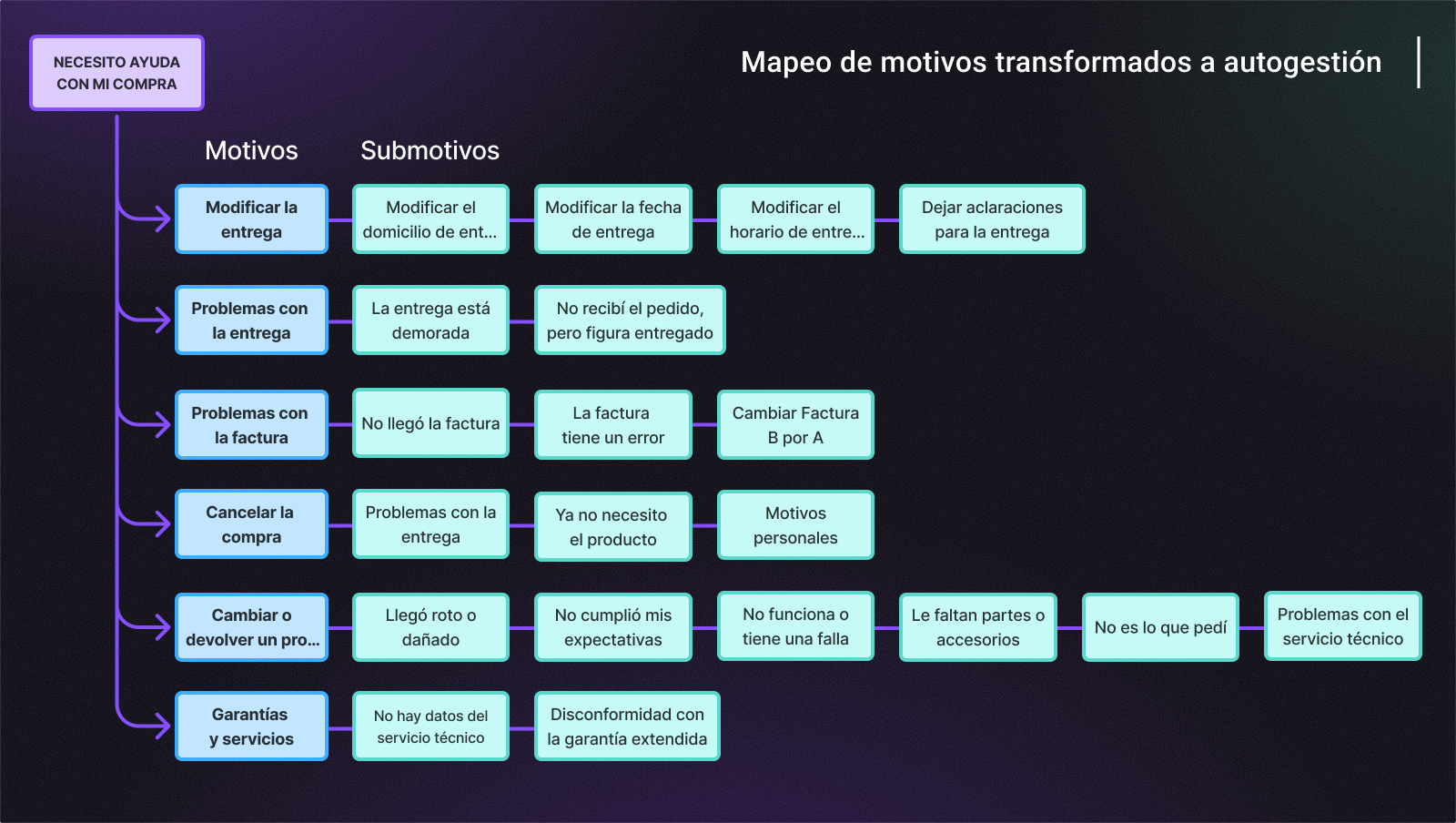
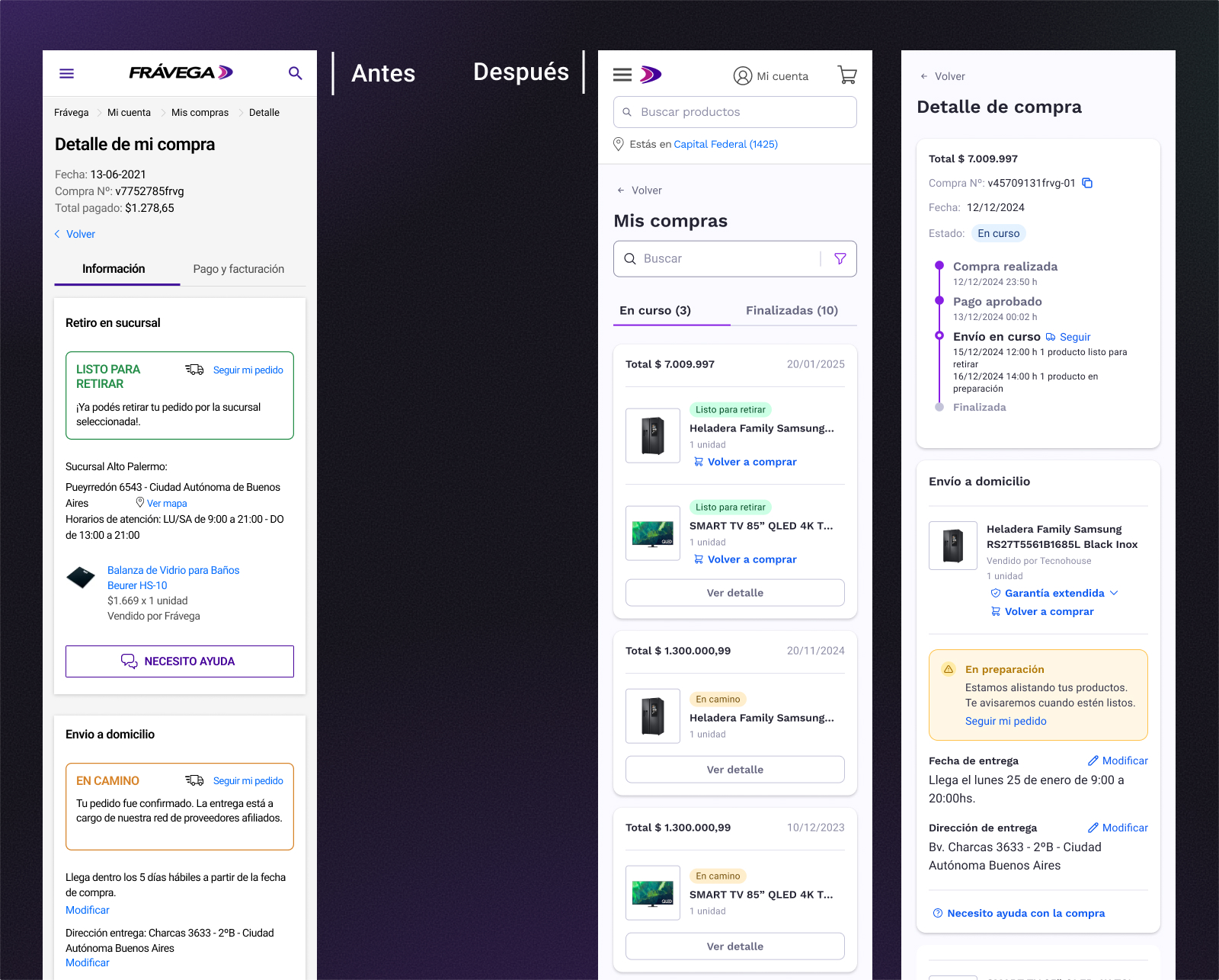
Scope: Desktop and mobile web. Six groups of requests (change delivery, delivery issues, invoice, cancellation, exchanges and returns, warranty) and a redesign of "Mis compras" (My purchases) with in-house order tracking, a new information architecture and the design system.
The challenge
"Mis compras" only let customers see their purchases. Order tracking depended on each logistics carrier's model, with no experience of our own, and the only form of self-service was the help center. For almost any request, the customer had to call.
To resolve things quickly, customer service agents often ended up canceling the purchase, because it was the shortest path. What could have been solved with a rescheduling or an exchange became a lost sale.
The problem also cut across every area: Logistics, Billing, Technical Service and Customer Service were involved in different procedures, with slow processes that differed for each case. And the starting point was in the data: in the experience surveys, not understanding order tracking was the leading cause of detraction.
There was no resistance between teams, but there was a real technical constraint: enabling self-service created a lot of work outside their scope, and that limited how much could be built and how.
Key leadership decisions
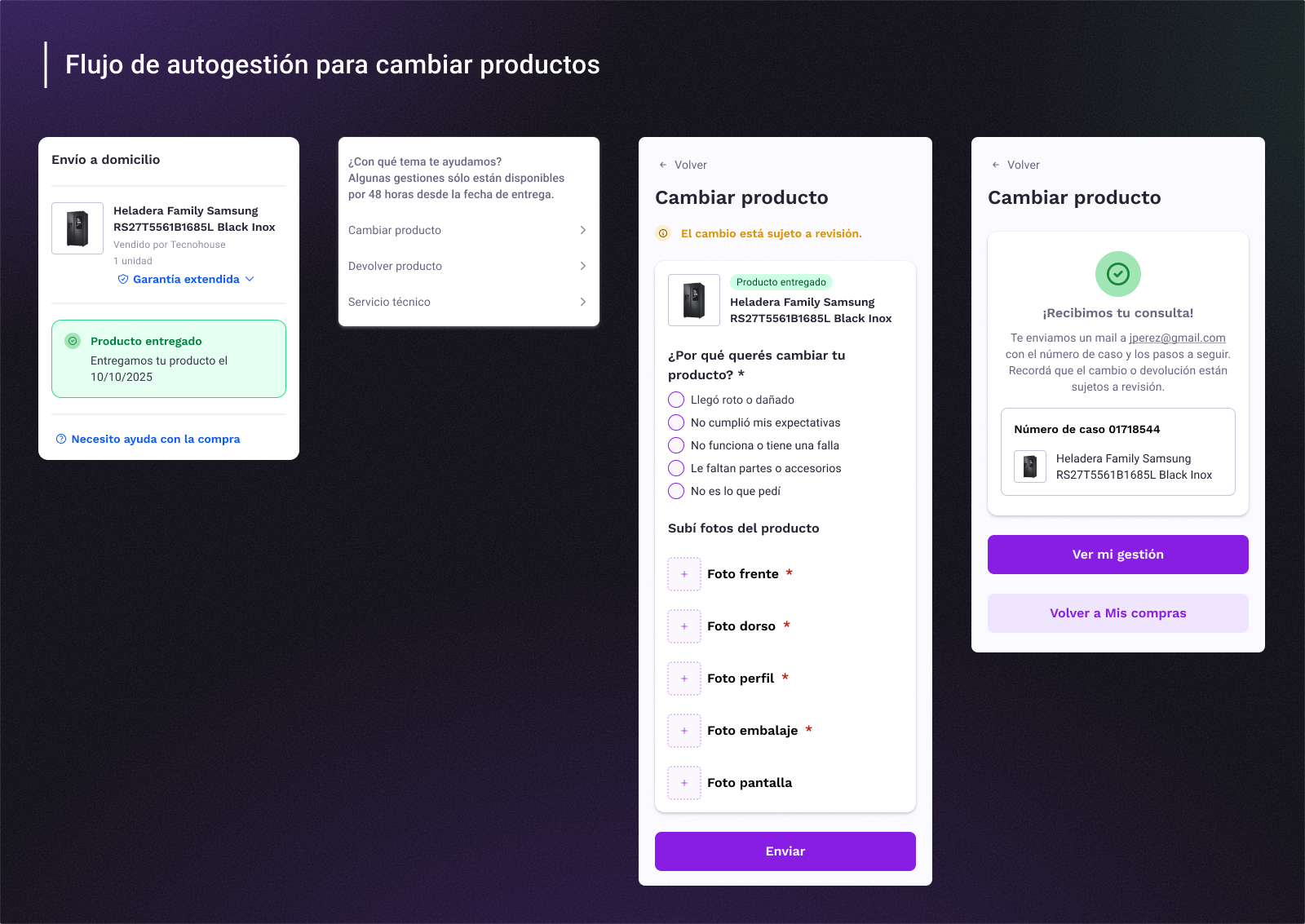
I started from real support cases: we mapped the scenarios the Customer Service team handled and, for each one, decided whether it called for a self-service solution or a referral to a communication channel. Where the answer was already defined, we went straight to self-service; where the customer needed to provide something (images, documents), we moved that step forward into a flow within Post-sale.
I prioritized by impact on the support team: we started with the two main contact reasons, changing or rescheduling delivery and exchanges and returns, and continued in order of complaint reasons. In the "Mis compras" redesign, we first added the tracking timeline and then the new information architecture.
I enabled unified in-house tracking: together with Logistics, which unified the tracking systems into a single in-house one and defined what information is shown from each carrier, we replaced third-party tracking models with a consistent experience in "Mis compras".
I designed a co-creation workshop so the proposal would belong to everyone: we put it together with the product designer, defining the activities and participants: 3 people from Customer Service, 2 Development leads, 2 product owners and 2 from UX. We presented the low-fidelity proposals and each participant sketched their input. The goal was to align product, development and customer service before building.
I grounded the discovery in external and internal evidence: a benchmark focused on help centers, order tracking and "Mi cuenta" (My account), along with the experience surveys as a starting point.
Organizational impact
NPS (post-delivery survey): +12 points over a 6-month period.
Calls to the customer service center: -20%. This result is shared with the redesign of email communications: both lines of work ran in parallel on the same sections, so it's hard to attribute the impact to each action separately.
Order tracking: negative mentions about tracking, which was the leading cause of detraction, went down, and tracking CES (effort) improved.
Current status: all self-service flows are implemented. The timeline, the new information architecture and the "Mis compras" redesign are already in production, built on the design system.
Learnings
I learned to include Development teams from the start, and to bring in key players from other teams, such as Logistics, from the beginning. In this project, much of what made the solution possible depended on areas that joined later than ideal.
If I started it today, I'd think in smaller projects and validate them before moving forward. It was hard to reach a solution that could be built, and smaller deliveries would have shortened that path.